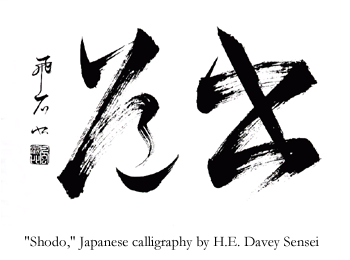
Thursday, February 23, 2017

Kobara Ranseki Sensei

Kobara Ranseki Sensei was one of the world's preeminent masters of Japanese calligraphy and ink painting. He studied classical Japanese art for over 50 years, winning numerous awards in international exhibitions. Kobara Sensei received Kyokujitsu Tanko Sho—the “Order of the Rising Sun (with Silver Rays)”—from the Japanese government for his numerous years of promoting and preserving traditional Japanese art and culture via his contributions to shodo and tea ceremony. This rarely bestowed award comes in the form of the Kunsho, a Medal of Honor.

Ranseki Sho Juku shodo, his method of instruction, continues to this day at a private club in Oakland, California called Wanto Shodo Kai ("East Bay Japanese Calligraphy Association"). The teachers at the Wanto Shodo Kai are Hiseki Davey Sensei and Miyauchi Somei Sensei, both of whom received the highest possible rank in Ranseki Sho Juku shodo.

Davey Sensei is offering instruction in Integrated Shodo & Meditation to the general public at his Sennin Foundation Center for Japanese Cultural Arts. Interested parties should visit www.senninfoundation.com and/or purchase a copy of The Japanese Way of the Artist at www.amazon.com. This book contains the most detailed biography of Kobara Sensei in print, along with information about his system of brush calligraphy

Tuesday, February 21, 2017

Amazing New Book!


“A simple guide to effective meditation that moves the reader from concentration to genuine meditative experience. The author maintains that such experiences are actually natural to us and that ‘harsh ascetic practice’ is unnecessary. Sawai Atsuhiro shows that meditation teaches how to deal with the stresses of modern life, improves one's general health, and can lead to the realization that we are one with the universe. Several methods of effective meditation are described. This is a book that will cause even the casual reader to want to meditate.”

Robert E. Carter, author of Encounter with Enlightenment and Becoming Bamboo: Western and Eastern Explorations of the Meaning of Life

Sawai Atsuhiro’s The True Paths to Meditation masterfully explains simple and profound forms of meditation, which the author learned from the celebrated founder of yoga in Japan, Nakamura Tempu. Mr. Nakamura taught Shin-shin-toitsu-do (“The Way of Mind and Body Unification”) for five decades, authored popular books and trained many of Japan’s most notable people in government, business, sports, martial arts, and entertainment.

As one of Mr. Nakamura’s closest students, Mr. Sawai received the highest level of teaching certification in Shin-shin-toitsu-do from him. He is a retired college professor and a bestselling author of meditation books in Japan. He is also the President of the International Japanese Yoga Association in Kyoto, which has members in over 20 nations.

In The True Paths to Meditation, his first English language book specifically written for Westerners, Mr. Sawai provides comprehensive insights into his unique life philosophy, evolved from over 50 years of Zen and yogic meditation. He also introduces methods to release the power of ki—the life energy of the universe. Using the forms of meditation in this book, you can realize deeper calmness, concentration, willpower, and a more positive way of living.

Complete with useful photos, a handy glossary, and suggestions for ongoing practice, The True Paths to Meditation will appeal to folks new to meditation as well as experienced meditators.

Look inside the book: https://www.amazon.com/True-Paths-Meditation-Sawai-Atsuhiro-ebook/dp/B00LH4QGJM/ref=tmm_kin_swatch_0?_encoding=UTF8&qid=1487715342&sr=8-1

Friday, November 29, 2013

An Important New Book


The Teachings of Tempu: Practical Meditation for Daily Life details the life and meditation techniques of Nakamura Tempu (1876-1968). Mr. Nakamura taught Shin-shin-toitsu-do (“The Way of Mind and Body Unification”) for over 50 years and authored bestselling books. He trained over 100,000 people, including members of the Japanese Imperial Family, government officials, business leaders, top athletes, celebrated actors, martial arts experts, and notable novelists. 

The book begins with Mr. Nakamura’s early years and a global quest to cure his tuberculosis. This search took him to the USA, where he studied medicine at Columbia University. Next, he traveled to Europe, where he lived with actress Sarah Bernhardt and researched psychology. In Egypt he encountered Kaliapa, an Indian mystic and yoga master, who brought him to India for a final attempt to save his life. After austere meditation in the Himalayas, Nakamura Tempu attained enlightenment, shook off the bonds of illness, and returned to Japan a changed man. 

The Teachings of Tempu uses episodes from Mr. Nakamura’s life to introduce his philosophy of mind and body unification, his forms of meditation, and how these skills can help you attain better health as well as deeper calmness, concentration, and willpower. It contains rare photos from Japan, which chronicle his long life. Also featured are extensive quotes from his books, the first time his writing has been offered in English. The Teachings of Tempu presents experiments and exercises you can try at home to understand mind and body unification—the essence of Mr. Nakamura’s realization and the secret to unlocking human potential. Illustrations of these exercises and forms of meditation are provided, along with an Introduction by Sawai Atsuhiro, a leading teacher of Shin-shin-toitsu-do and a direct student of Mr. Nakamura. Dr. Robert Carter, author and Professor Emeritus of Philosophy for Canada’s Trent University, wrote the Foreword.


Monday, March 11, 2013

From the Author

From the Author of Brush Meditaton and The Japanese Way of the Artist

AN INTRODUCTION TO JAPANESE CALLIGRAPHY AND MY BOOK
Within our lifetimes, we are witnessing the meeting of East and West; the fact that both Asian and Western cultures have a variety of good points as well as bad points is fairly obvious. What is perhaps not as evident is my supposition that through a positive, non-biased process of Eastern and Western cultural exchange, a new, more balanced, more enlightened global culture may result. Moreover, while I explore calligraphic painting (shodo) as well as other Japanese cultural arts in Brush Meditation—A Japanese Way to Mind & Body Harmony, and although I made an attempt to examine the meditative aspects of shodo and various Japanese arts, one of the main reasons I wrote this book is to let other Westerners know that it is possible, and meaningful, for non-Japanese to participate in traditional Japanese art forms.

At their deepest levels, the martial arts (budo), tea ceremony (chado), flower arrangement (kado), calligraphy (shodo), and other Japanese arts, are the same. Despite their obvious physical differences, these arts share a common set of aesthetics; and more importantly, they require the acquisition of identical positive character traits if you are to become successful in their performance. Note that many of these arts end in the word "do." Do means "the way," and it indicates that a given activity has transcended its utilitarian function, that this action has, furthermore, been elevated to the level of art, and that its proponents are teaching it as a way of life. In sum and substance then, a do form is an art which allows you to grasp the ultimate nature of the whole of life by examining yourself in great detail through a singular aspect of life. In other words, to grasp the universal through the particular.

Many artistic principles and important mental states are universal for the various Japanese ways. One of the most significant and basic principles that these arts share is the concept of mind and body coordination. While few of us are required to use a brush in daily life, most people are interested in realizing their full potential and enhancing their mental state as well as physical health. Since integrating the mind and body allows us to accomplish these aims, the relationship between the mind and body, along with how to achieve a state of mind-body harmony, is one of the main themes of Brush Meditation.

In the case of painting, some adherents may speak of a "unity of mind and brush," and make statements which indicate that "if the mind is correct, the brush is correct." In Japanese swordsmanship, it is not uncommon to speak of a unity of mind, body, and sword. Likewise, in Zen meditation, students are encouraged to arrive at a state of mind and body coordination, a state of "self-harmony." All of these assertions point to the necessity of integrating the mind and body in action. Mental and physical harmony is also vital for realizing your full potential in daily living, and it remains one of the central elements needed for mastery of any of the classical Japanese ways.

Yet, perhaps surprisingly, although I serve as Director of the Sennin Foundation Center for Japanese Cultural Arts, I'm not teaching and pursuing the above-mentioned art forms, due to an overwhelming interest in Japanese culture. While I certainly am, of course, interested in Japan, my main intention in studying these arts is to examine the nature of the self, the universe, and life as a whole. This point is vital, as the miscellaneous "do" all indicate a "way" that transcends boundaries and limitations. It is in the end not a "Japanese way," but rather a human way, and ultimately, the Way of the Universe.

In Brush Meditation, shodo, or Japanese brush writing, is used as a representative example of how the various do forms help us to discover principles that relate universally to all aspects of living, and which can enhance our lives. Brush Meditation starts off with a brief history of calligraphy and painting in Asia and explains why these arts hold relevance for the West. Following this is an explanation of mind-body unification in shodo and painting, as well as the actual techniques of controlling the brush. The aesthetics and principles, which are universal for Japanese cultural arts, will also be explored, along with their importance for cultivating calmness and concentration. Of course, a few introductory lessons in brush meditation, calligraphy, and painting are included. Sources for shodo and painting supplies are also detailed in the appendix.

In conclusion, I am not a master of any of the above topics. Still, I have had unique opportunities to study, in both the U.S. and Japan, Japanese arts that remain inaccessible to many people in the West. It is my wish to share with interested others a bit of what I have been able to absorb about these art forms. Even more, this book amounts to an act of personal study, self-examination, and analysis that I hope will also be relevant to other people interested in art, meditation, and/or Japanese culture.

Sunday, January 6, 2013

Review of Brush Meditation, Part of The Japanese Way of the Artist Anthology

"As a highly ranked, well-respected instructor of various arts, including classical martial arts, Japanese yoga, and shodo (calligraphy), H. E. Davey is able to discuss shodo in terms of wider spiritual and philosophical implications for the non-practitioner and, indeed, for anyone seeking insights and ideas from Asian culture and traditions. This is an unusual talent and a rare gift, and Davey speaks from an unusual perspective of awareness, position, and repute."
--Wayne Muromoto, publisher, The Classic Budoka blog

Friday, November 2, 2012

From The Japanese Way of the Artist


"Certain philosophical and aesthetic standards are shared by all Japanese arts. From the martial arts, to Japanese dance, to flower arrangement, distinctive artistic codes are held in common. These aesthetic codes have had a profound effect on the unfolding of the Ways."--H. E. Davey, The Japanese Way of the Artist

Thursday, May 31, 2012

Japanese Yoga: The Way of Dynamic Meditation

Great news! Japanese Yoga: The Way of Dynamic Meditation is back in print with a new publisher. Michi Publishing is starting to release new copies of this landmark book to the public, and you should be able to order a special signed edition from www.senninfoundation.com very soon. 

The Sennin Foundation Center for Japanese Cultural Arts is scheduled to receive Japanese Yoga on June 11, 2012. Check the website after this date to order your own personal copy of this meditation classic. Paypal and major credit cards will be accepted, and international orders are encouraged.  

Based on the eclectic Western-Eastern teachings of Nakamura Tempu Sensei, this step-by-step introduction to Japanese yoga (Shin-shin-toitsu-do) presents stretching, healing, and meditation exercises designed for mind/body integration. It is the only book in English to detail the life and teachings of Mr. Nakamura. In Japanese yoga, which is based on mind and body unification principles, the ultimate goal is enhanced concentration, calmness, and willpower for a longer, healthier, and fuller life. Author H. E. Davey Sensei also shows how Japanese yoga relates to various classical Japanese arts as part of a tradition of spiritual practice with spiritual and aesthetic roots in India, Japan, and the West.

Developed by Nakamura Tempu Sensei in the early 1900s from Indian Raja yoga, Japanese martial arts and meditation practices, as well as Western medicine and psychotherapy, Japanese yoga offers a new approach to experienced yoga students and a natural methodology that newcomers will find easy to learn. After a brief history of Shin-shin-toitsu-do, H. E. Davey Sensei presents Mr. Nakamura's Four Basic Principles to Unify Mind and Body. These principles relate the meditative experience to the movement of everyday living and thus make it a "dynamic meditation." Each of the Four Basic Principles is illustrated with step-by-step explanations of practical experiments.

Readers are then introduced to different forms of seated and moving meditation, health exercises, and self-healing arts. All these are linked back to the Four Basic Principles and can enhance performance in art, music, business, sports, and other activities. Readers learn to use Japanese yoga techniques throughout the day, without having to sit on the floor or seek out a quiet space.

Included at the end of the book are simple but effective stretching exercises, information about ongoing practice, and a glossary and reference section. Amply illustrated and cogently presented, Japanese Yoga: The Way of Dynamic Meditation belongs on every mind/body/spirit reading list.
 

Japanese Yoga was initially published in 2001, and it was the first and only English language book on the mind and body unification teachings of Nakamura Sensei. It still is, and Mr. Davey will personally sign your copy of this milestone work. Drop by www.senninfoundation.com after June 11 and order Japanese Yoga for yourself or your friends. 

"Will make many yogis feel right at home...
Davey's readable, friendly guide is definitely worth a look." - Yoga Journal


Wednesday, February 15, 2012

No art takes places without inspiration. Every artist also needs effective knowledge of his or her tools (e.g., does a certain brush function well with a particular kind of paint?). What’s more, artists need effective techniques for using those tools.

Likewise, to express ourselves skillfully with maximum efficiency and minimum effort, we need to investigate the most effective ways of using the mind and body since, in the end, they are the only “tools” we truly possess in life.

H. E. Davey, Japanese Yoga: The Way of Dynamic Meditation

Sunday, December 18, 2011

Kobara Sensei 7th Year Memorial Service


On December 17th, 2011 the Seventh Year Memorial Service for Kobara Ranseki Sensei took place at the Buddhist Church of San Francisco at 1:00 PM. Kobara Sensei was the founder and Shihan ("Headmaster") of the Ranseki Sho Juku system of Japanese calligraphy and painting as well as the Vice President of the Kokusai Shodo Bunka Koryu Kyokai, which is based in Urayasu, Japan.

The private service was attended by around 20 people, mostly members of the Kobara family and H. E. Davey Sensei and Miyauchi Somei Sensei, two of his closest students of shodo. Although Kobara Sensei taught many people the ancient art of brush calligraphy over several decades, only four people ever received Shihan-Dai, the highest level of teaching certification. Davey Sensei and Miyauchi Sensei are the last two living Shihan-Dai of Ranseki Sho Juku shodo. They lead the Wanto Shodo Kai, "East Bay Shodo Association," in Oakland, California. Davey Sensei is also the Director of the Sennin Foundation Center for Japanese Cultural Arts, where classes in Integrated Shodo & Meditation are offered.

A Jodo Shinshu Buddhist service started the event, followed by a traditional offering of incense to Kobara Sensei by members of his family, Miyauchi Sensei, and Davey Sensei. The memorial service closed with comments from Kobara Kazuko, Kobara Sensei's wife. She recalled his deeply spiritual nature, how he viewed most everyone as members of his family, and how his last words were expressions of gratitude.

Following the service, refreshments were offered at the church social hall, which contained pictures of Kobara Sensei as a child, teaching shodo, receiving awards at international shodo exhibitions, and being presented with the Order of the Rising Sun by the Japanese government.

Monday, December 5, 2011

From the Author


Living the Japanese Arts & Ways is out of print, but the entire book is now offered in The Japanese Way of the Artist (Stone Bridge Press). What's more, you'll also get two of my other out of print titles: Brush Meditation and The Japanese Way of the Flower.

Shodo (the "Way of Japanese calligraphy"), budo (the "martial Way"), and kado (the "Way of flower arrangement") are just some of the numerous Japanese arts ending in “Do,” indicating “the Way.” Nonetheless, how these arts function as Ways isn’t always understood.

It’s common to state that these various disciplines represent a Way of life (thus the designation “Do”), and that by practicing, we can transcend them and grasp the art of living. While this is true, it’s uncommon to find a teacher (or book) that can explain how such Do forms lead to spiritual realization. While some books pay lip service to the ideal of the Way producing spiritual evolution, they also sometimes fail to offer direct explanations and methodologies to help students realize the Way. It’s frequently assumed that merely manipulating a brush or throwing an opponent will produce profound realizations.

This is untrue and unfortunate. It’s untrue because it’s the manner in which we approach the Ways that determines what we learn from them. Spiritual realization isn’t guaranteed.

It’s unfortunate because the conscious practice of Japanese Do forms truly can result in the cultivation of mind and body. But to use them as meditation, we must investigate exactly how they can lead to realization.

Japanese calligraphy, flower arrangement, tea ceremony, martial arts, and other Do has been the subject of numerous books. Few of these works, however, have explored how they go beyond art and enter into spirituality. Even fewer have offered methods to practice what can be thought of as “moving meditation,” and which are needed for personal growth to take place.

My book was written to answer that need, and I'm grateful for the kind reviews as well as the positive worldwide response.

Friday, October 7, 2011

Mu

A number of Ways (Do), owing to the fact that a Do is a particular expression of the Way of the universe itself, have used the term mu to point to the sum and substance of the universe. And since it is the mind after all that perceives the absolute universe, various mental states in the Ways have appellations that utilize the character for mu as well. Originating in Buddhism, but having parallels in other religions, mu means, “the void,” or “nothingness.”--H. E. Davey, The Japanese Way of the Artist

Thursday, September 1, 2011

About Japanese Calligraphy: By H. E. Davey


Expanded attention, deeper relaxation, increased focus and resolve . . . shodo students have a chance to achieve lasting spiritual transformation through the classical art of Japanese calligraphy (shodo). Simple step-by-step exercises let beginners and non-artists alike work with brush and ink to reveal their mental and physical state through moving brush meditation.

Kanji, or "characters," used in
both Japan and China, have transcended their utilitarian function and collectively can serve as a visually stirring piece of fine art. Shodo allows the dynamic movement of the artist's spirit to become observable in the form of rich black ink. In shodo, you can sense both the rhythm of music as well as the smooth, elegant, and balanced construction of architecture. Many practitioners feel that the "visible rhythm" of Japanese calligraphy embodies a "picture of the mind"--and calligraphers recognize that it discloses our spiritual state. This recognition is summed up by the traditional Japanese saying: Kokoro tadashikereba sunawachi fude tadashi--"If your mind is correct, the brush will be correct."

Some Japanese calligraphers and psychologists have written books on the examination of our personality through calligraphy. Just as Western companies have employed handwriting analysts to help them select the best individuals for executive posts, the Japanese have traditionally expected their leaders in any field to display fine, composed script. This stems from the belief that brush strokes reveal the state of the body and subconscious mind--its strengths and weaknesses--at the moment the brush is put to paper. It has also been held that the subconscious can be influenced in a positive manner by studying and copying consummate examples of calligraphy by extraordinary individuals. Japanese tradition teaches that by using this method, we can cultivate strength of character akin to that of the artist being copied. Since shodo is an art form, it's not strictly necessary to be able to read Chinese characters, or the Japanese phonetic scripts of hiragana and katakana, to admire the dynamic beauty of shodo. Within Japanese calligraphy, we find essential elements that constitute all art: creativity, balance, rhythm, grace, and the beauty of line. These aspects of shodo can be recognized and appreciated by every culture.


Monday, August 22, 2011

Excerpt

Harmony is a central aspect of shodo. Harmony is frequently expressed through a state of dynamic balance. Balance in shodo is asymmetrical, which produces an active feeling of movement within the characters. One could liken it to a picture of a sprinter whose inclined running posture has been frozen by the camera. Seeing such a picture, you instantly have a sensation of movement, but this sensation is different from what you experience when viewing a photo taken of a runner at the moment he trips and is falling forward. Both photos show bodies inclined in the direction in which they are moving; the difference between the two is balance. Balance in shodo can also be witnessed through a natural alternation of heavy and light brush pressure, which in turn produces an oscillation of thick and thin lines of ink. If all the brush strokes are of equal thickness the work looks stilted, unnatural, and dead. --The Japanese Way of the Artist

Friday, April 8, 2011

About the Book

Review

"H. E. Davey combines a remarkable technical facility in the Japanese art of the brush with a deep understanding of its spiritual profundities. His book offers a marvelous practical introduction to Japanese calligraphy as well as insights into the essence of the art. It is a unique and fascinating presentation of a little-known art of self-cultivation." -Dave Lowry, author of Sword and Brush 

Product Description

Based on traditional Japanese shodo, "the Way of Calligraphy," Brush Meditation introduces beginners and non-artists alike to working with brush and ink as a form of "moving meditation." By showing you how the most elemental brush strokes reveal your physical and mental state, it teaches you to become "one with the brush," attuned to the underlying principles of life and nature. As the text explores the intricate relationships of mind, body, and brush, it delves into the mysteries of human life energy, or ki, and the power of the hara, a natural abdominal center. Simple exercises demonstrate how to use the brush in spiritual practice, while illustrations guide every step. In the Appendix is information about how to find more formal instruction as well as sources for brushes, ink, and paper.

From the Publisher

Brush Meditation is part of Stone Bridge Press's MICHI: JAPANESE ARTS AND WAYS series. From chado--"the Way of tea"--to budo--"the martial Way"--Japan has succeeded in spiritualizing a number of classical arts. The names of these skills often end in Do, also pronounced Michi, meaning the "Way." By studying a Way in detail, we discover vital principles that transcend the art and relate more broadly to the art of living itself. Featuring the work of H. E. Davey and other select authors, books in the series MICHI: JAPANESE ARTS AND WAYS focus on these Do forms. They are about discipline and spirituality, about moving from the particular to the universal... to benefit people of any culture.

About the Author

H. E. Davey is founder and director of the Sennin Foundation Center for Japanese Cultural Arts and the author of The Japanese Way of the Flower: Ikebana as Moving Meditation. He lives in the San Francisco Bay Area.

Excerpt. © Reprinted by permission. All rights reserved.

"Western and Japanese practitioners of shodo cite expanded attention, improved peacefulness, stronger will power, and deeper relaxation as just some of the advantages of their training." 

Friday, March 11, 2011

Japan Earthquake and Tsunami

Our thoughts go out to our friends and teachers in Japan, which was recently hit by a large earthquake and tsunami. We hope all our friends are OK, and we hope you will donate to help people in Japan. If you’re not sure how to do this, you can go to http://www.globalgiving.org/projects/japan-earthquake-tsunami-relief/.

Thursday, February 24, 2011

About Brush Meditation

H. E. Davey combines a remarkable technical facility in the Japanese art of the brush with a deep understanding of its spiritual profundities. His book offers a marvelous practical introduction to Japanese calligraphy as well as insights into the essence of this art. It is a unique and fascinating presentation of a little-known art of self-cultivation.--Dave Lowry, author of Sword and Brush

Wednesday, January 19, 2011

Tuesday, November 9, 2010

Fudoshin Calligraphy


This is H. E. Davey’s calligraphy of fudoshin, or “immovable mind.” You can click on the images to enlarge them.

Fudoshin is the goal of many Japanese arts and forms of meditation. It doesn’t describe a rigid, hardheaded state of mind, but rather a condition of complete mental stability, one that isn’t easily disturbed by whatever comes up in life.

It is painted using sosho and gyosho scripts, in the style of master calligrapher Kobara Ranseki Sensei. This piece of artwork was featured in Furyu magazine, along with the books Brush Meditation and The Japanese Way of the Artist.

All skillful Japanese calligraphy should display a unity of calm and action. In this case, Davey Sensei’s brushwork is so dynamic that it appears to be moving, but each character is still balanced and composed. This is the result of over 25 years of shodo training in the USA and Japan.

You can commission Davey Sensei, Brush Meditation author, to create this fudoshin calligraphy for your home, office, or meditation room. He can be contacted at hedavey@aol.com.

Sunday, November 7, 2010

H. E. Davey's Calligraphic Art

These two scrolls by Hiseki Davey Sensei were shown at a major exhibition of Japanese calligraphy held in San Francisco in 2000. They also were shown at the Kokusai Shodo Ten in Urayasu, Japan, where they received top awards.

The calligraphy on the left is an example of Davey Sensei's kanji art, and the Chinese characters read, "Rocky mountains are embraced by white clouds." The art on the right is an example of his kana calligraphy, with a large Chinese character meaning "waterfall," which was painted to resemble a waterfall. It reads, "The waterfall no longer flows, but its sound remains in my mind and heart."

Davey Sensei can create similar hanging scrolls for your home or office. Contact him at hedavey@aol.com.

Japanese Yoga

http://senninfoundation.com/davey_yoga.html