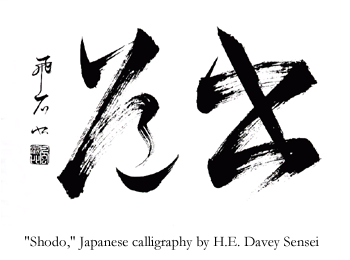
A number of Ways (Do), owing to the fact that a Do is a particular expression of the Way of the universe itself, have used the term mu to point to the sum and substance of the universe. And since it is the mind after all that perceives the absolute universe, various mental states in the Ways have appellations that utilize the character for mu as well. Originating in Buddhism, but having parallels in other religions, mu means, “the void,” or “nothingness.”--H. E. Davey, The Japanese Way of the Artist
Friday, October 7, 2011
Thursday, September 1, 2011
About Japanese Calligraphy: By H. E. Davey
Expanded attention, deeper relaxation, increased focus and resolve . . . shodo students have a chance to achieve lasting spiritual transformation through the classical art of Japanese calligraphy (shodo). Simple step-by-step exercises let beginners and non-artists alike work with brush and ink to reveal their mental and physical state through moving brush meditation.
Kanji, or "characters," used in both Japan and China, have transcended their utilitarian function and collectively can serve as a visually stirring piece of fine art. Shodo allows the dynamic movement of the artist's spirit to become observable in the form of rich black ink. In shodo, you can sense both the rhythm of music as well as the smooth, elegant, and balanced construction of architecture. Many practitioners feel that the "visible rhythm" of Japanese calligraphy embodies a "picture of the mind"--and calligraphers recognize that it discloses our spiritual state. This recognition is summed up by the traditional Japanese saying: Kokoro tadashikereba sunawachi fude tadashi--"If your mind is correct, the brush will be correct."
Some Japanese calligraphers and psychologists have written books on the examination of our personality through calligraphy. Just as Western companies have employed handwriting analysts to help them select the best individuals for executive posts, the Japanese have traditionally expected their leaders in any field to display fine, composed script. This stems from the belief that brush strokes reveal the state of the body and subconscious mind--its strengths and weaknesses--at the moment the brush is put to paper. It has also been held that the subconscious can be influenced in a positive manner by studying and copying consummate examples of calligraphy by extraordinary individuals. Japanese tradition teaches that by using this method, we can cultivate strength of character akin to that of the artist being copied. Since shodo is an art form, it's not strictly necessary to be able to read Chinese characters, or the Japanese phonetic scripts of hiragana and katakana, to admire the dynamic beauty of shodo. Within Japanese calligraphy, we find essential elements that constitute all art: creativity, balance, rhythm, grace, and the beauty of line. These aspects of shodo can be recognized and appreciated by every culture.
Kanji, or "characters," used in both Japan and China, have transcended their utilitarian function and collectively can serve as a visually stirring piece of fine art. Shodo allows the dynamic movement of the artist's spirit to become observable in the form of rich black ink. In shodo, you can sense both the rhythm of music as well as the smooth, elegant, and balanced construction of architecture. Many practitioners feel that the "visible rhythm" of Japanese calligraphy embodies a "picture of the mind"--and calligraphers recognize that it discloses our spiritual state. This recognition is summed up by the traditional Japanese saying: Kokoro tadashikereba sunawachi fude tadashi--"If your mind is correct, the brush will be correct."
Some Japanese calligraphers and psychologists have written books on the examination of our personality through calligraphy. Just as Western companies have employed handwriting analysts to help them select the best individuals for executive posts, the Japanese have traditionally expected their leaders in any field to display fine, composed script. This stems from the belief that brush strokes reveal the state of the body and subconscious mind--its strengths and weaknesses--at the moment the brush is put to paper. It has also been held that the subconscious can be influenced in a positive manner by studying and copying consummate examples of calligraphy by extraordinary individuals. Japanese tradition teaches that by using this method, we can cultivate strength of character akin to that of the artist being copied. Since shodo is an art form, it's not strictly necessary to be able to read Chinese characters, or the Japanese phonetic scripts of hiragana and katakana, to admire the dynamic beauty of shodo. Within Japanese calligraphy, we find essential elements that constitute all art: creativity, balance, rhythm, grace, and the beauty of line. These aspects of shodo can be recognized and appreciated by every culture.
Monday, August 22, 2011
Excerpt
Harmony is a central aspect of shodo. Harmony is frequently expressed through a state of dynamic balance. Balance in shodo is asymmetrical, which produces an active feeling of movement within the characters. One could liken it to a picture of a sprinter whose inclined running posture has been frozen by the camera. Seeing such a picture, you instantly have a sensation of movement, but this sensation is different from what you experience when viewing a photo taken of a runner at the moment he trips and is falling forward. Both photos show bodies inclined in the direction in which they are moving; the difference between the two is balance. Balance in shodo can also be witnessed through a natural alternation of heavy and light brush pressure, which in turn produces an oscillation of thick and thin lines of ink. If all the brush strokes are of equal thickness the work looks stilted, unnatural, and dead. --The Japanese Way of the Artist
Friday, April 8, 2011
About the Book
Review
"H. E. Davey combines a remarkable technical facility in the Japanese art of the brush with a deep understanding of its spiritual profundities. His book offers a marvelous practical introduction to Japanese calligraphy as well as insights into the essence of the art. It is a unique and fascinating presentation of a little-known art of self-cultivation." -Dave Lowry, author of Sword and Brush
Product Description
Based on traditional Japanese shodo, "the Way of Calligraphy," Brush Meditation introduces beginners and non-artists alike to working with brush and ink as a form of "moving meditation." By showing you how the most elemental brush strokes reveal your physical and mental state, it teaches you to become "one with the brush," attuned to the underlying principles of life and nature. As the text explores the intricate relationships of mind, body, and brush, it delves into the mysteries of human life energy, or ki, and the power of the hara, a natural abdominal center. Simple exercises demonstrate how to use the brush in spiritual practice, while illustrations guide every step. In the Appendix is information about how to find more formal instruction as well as sources for brushes, ink, and paper.
From the Publisher
Brush Meditation is part of Stone Bridge Press's MICHI: JAPANESE ARTS AND WAYS series. From chado--"the Way of tea"--to budo--"the martial Way"--Japan has succeeded in spiritualizing a number of classical arts. The names of these skills often end in Do, also pronounced Michi, meaning the "Way." By studying a Way in detail, we discover vital principles that transcend the art and relate more broadly to the art of living itself. Featuring the work of H. E. Davey and other select authors, books in the series MICHI: JAPANESE ARTS AND WAYS focus on these Do forms. They are about discipline and spirituality, about moving from the particular to the universal... to benefit people of any culture.
About the Author
H. E. Davey is founder and director of the Sennin Foundation Center for Japanese Cultural Arts and the author of The Japanese Way of the Flower: Ikebana as Moving Meditation. He lives in the San Francisco Bay Area.
Excerpt. © Reprinted by permission. All rights reserved.
"Western and Japanese practitioners of shodo cite expanded attention, improved peacefulness, stronger will power, and deeper relaxation as just some of the advantages of their training."
Friday, March 11, 2011
Japan Earthquake and Tsunami
Our thoughts go out to our friends and teachers in Japan , which was recently hit by a large earthquake and tsunami. We hope all our friends are OK, and we hope you will donate to help people in Japan . If you’re not sure how to do this, you can go to http://www.globalgiving.org/projects/japan-earthquake-tsunami-relief/.
Thursday, February 24, 2011
About Brush Meditation
H. E. Davey combines a remarkable technical facility in the Japanese art of the brush with a deep understanding of its spiritual profundities. His book offers a marvelous practical introduction to Japanese calligraphy as well as insights into the essence of this art. It is a unique and fascinating presentation of a little-known art of self-cultivation.--Dave Lowry, author of Sword and Brush
Wednesday, January 19, 2011
The Japanese Way of the Artist
To read more about Japanese art and meditation, check out The Japanese Way of the Artist. You can order your copy at:
Subscribe to:
Posts (Atom)